| Author’s Note This piece documents personal experience and publicly accessible discourse during an ongoing season of grief. It does not allege wrongdoing, infer motive, or attribute criminal conduct to any individual or institution. Any public material referenced is discussed solely for its impact on my family’s lived experience and for the purpose of illustrating the risks of narrative pressure, secondary trauma, and unguarded speculation during periods of acute loss. I write as a wife, a mother, a Christian, and an academic committed to truth, restraint, and the dignity of those most vulnerable in moments of grief.] |
“You will keep in perfect peace those whose minds are steadfast,
because they trust in You.”
— Isaiah 26:3I was supposed to write this post months ago. Many may expect the unraveling. The raw spill of grief. The chaos of discovering him gone. This is not that blog post. This wife and mother. This child of the Most High God has been carried through a quiet transformation over these past eight months. Not by denial. Not by forgetting. But by being held, firmly and faithfully, by God Himself. I have come to know Him not as an abstract comfort, but as my Isaiah 54 Husbandman. The One who gathers, restores, defends and speaks tenderly to what has been broken. It is as though scales have fallen away. Scripture has opened itself with a clarity I had never known before. Not as text, but as breath. Not as theology, but as life. The Word no longer sits beside my suffering. It walks through it with me.
The Morning After Midnight has been written at least ten times. Each version marked a different place in my mind: confusion, pain and survival. Each draft was a breadcrumb trail through the wilderness of shock. And every time my hand hovered over publish, the Holy Spirit whispered the same instruction:
Not yet, Neetu. Hold still.
So I waited. And in the waiting, something holy happened. Peace did not arrive like sunlight through curtains. It came like breath returning after drowning. This is not The Morning After Midnight. This is what I found when morning did not come. This is Finding Peace in Faith and in that, strength. About that peace?…. That’s for another blog post.
My children and I have lived through things no family should ever have to name, let alone explain. Things that we never imagined would belong to us. Things we were never meant to survive. And yet God showed up. He kept His Word. He fought for us. There have been miracles, quiet, supernatural, innumerable, that cannot all be written here. What can be said is this: we are still here. In pain, yes. But stronger. Bold. Unapologetic about who we are. We closed our circles. We released what and who was shallow. We let go of those who revealed their true nature when we lost Ken…and it has been for the better. Sometimes God removes people not as punishment, but as preparation, making room for those who are truly anchored in Him, those who will walk beside you into the next season with reverence and steadiness. I am profoundly grateful for the ones He has brought into our lives.There are names that I will always speak with reverence.
My mother Meera. and elder sister Sharoma, who held the line when my body could not, who steadied my children when the ground would not stop shifting. Pastor Shane and Renee, who did not arrive with answers, but with presence. Who understood that faith is not noise, but constancy. Harvest Church. The Wednesday Group. The Perrymans. My neighbour Ameena. People who did not flinch. Who did not speculate. Who did not require explanation before offering cover. People who understood that grief does not need commentary. It needs shelter and the love of God to be poured out through them. And then, the lawyer that God sent into the arena with me. Not to posture. Not to perform. But to stand. To fight beside me …for my children, for my husband, for the truth that refuses to be managed quietly. A lawyer like no other . Priya Chetty. This is what support looks like when it is real. This is the person that everyone wants in their corner, Not applause. Not proximity. But willingness to stay when staying costs something.
These are the hands that held us up. And because God sent them.. we rose. Their names deserve their own page. That story will be told another day.
For now, this is what matters: We are still here.Since so many have asked for this third post, let this be what it is meant to be: not a descent into devastation, but an accounting of what my children and I have faced since Ken graduated to Heaven. Eternal life, after all, is the ultimate promise. And so I plant myself where truth stands , not loud, not frantic, not defensive … but unmoved
“When the mob and the press and the whole world tell you to move,
your job is to plant yourself like a tree beside the river of truth
and tell the whole world, ‘No — you move.’”
— Captain America: Civil War
Gosh! Ken and I loved that movie! There is a moment in every crisis when stillness becomes resistance.. When the noise grows so loud that movement is demanded , not because it is right, but because it is convenient. When grief is expected to perform, to explain itself, to cooperate with narratives already decided. When silence is misread as guilt, and restraint is treated as weakness. That is the moment this quote speaks to. Not the fantasy of heroism, but the discipline of remaining rooted when everything around you insists that truth must bend to urgency. To plant yourself , not in defiance, but in conviction. To refuse to be rushed, reshaped, or relocated simply because the crowd has grown impatient. That was the posture we were forced into. Not because we sought confrontation, but because we refused to abandon truth for comfort, or dignity for approval. Because when grief is real, it does not move on demand. And when truth matters, it does not yield to volume.
So this is where the lights come on. And the masks come off..
What Crawls on Its Belly Toward Grief When Decency Leaves the Room? That is an interesting question that warrants consideration. Let me set the stage:
We did not know that his missing-persons poster had gone viral.
Why would we?
We were busy learning how to breathe again.
BUT : Let us begin with the headline because it tells us everything we need to know.
“Missing Durban physiotherapist found dead at home.”
Tidy. Formal. Eye-catching…. yet true. After all… got to get that grabbing headline, right? A man’s life reduced to a logistical update,
Then comes the familiar softening strategy:
“Family and friends remember him as a beautiful, kind human being.”
Which is also true.
And also useful.
Because praise, when placed early, works like insulation. It signals virtue while preparing the reader for what follows. It distracts. It reassures. It creates the illusion of care .. just long enough to lower the reader’s guard.
And then, quietly, casually, the damage is done.
The Quote That Never Happened . [Note I refer here to the absence of any verified engagement with me or my children, not to an assertion of intent or fabrication.]
“We went to his home and asked to search the premises but the family said if he was there, their dog would have smelt his scent. So we left.”
This sentence deserves to be framed , not for journalism awards, but as a case study in how easily an unverified narrative can harden into print
Let us be clear.
No one spoke to “the family.”
Not to the wife.
Not to the children.
Not to anyone who mattered.
So exactly which family was being referred to here?
That ambiguity was not neutral. It was reckless. And it opened a floodgate of unwarranted speculation against my children and I. At the time this alleged conversation supposedly took place, we were not holding discussions.
We were holding each other upright.
We were not offering quotable remarks.
We were barely conscious.
Yet here it is…. a neat little anecdote, perfectly quotable, impressively cinematic, attributed to “the family,” published without verification, without corroboration, without a shred of journalistic caution.
It is astonishing how confidently this was printed.
More astonishing still is how casually it was believed.
Because it bears all the hallmarks of invention.
No named speaker.
No time reference.
No corroboration.
Only maximum dramatic utility.
This is how conjecture learns to walk upright.
How fiction acquires credibility simply by appearing in print.
How something unverified, repeated with confidence, begins to masquerade as truth , not because it is accurate, but because it is convenient.
This is not community concern.
It is narrative negligence.
AS IF TRAUMA SHARPENS INSIGHT
Our daughter was quoted swiftly. Publicly. Decisively.
She said the family “did not suspect foul play at this stage.”
At this stage.
Let us pause there.
One hour after she found her father.
Sixty minutes after her world split open.
Sixty minutes into a pain so raw that it had not yet found language.
That, apparently, was the perfect moment for journalists to go fishing. [whichever media house it may have been]
Because when something sacred breaks, there is always a certain type of person who smells opportunity.
They did not come with compassion.
They did not come with restraint.
They came with leading questions, with the moral hygiene of scavengers…. circling, sniffing, eager.
They wanted to know about foul play.
From a grieving daughter.
As if trauma sharpens insight.
As if shock is a credential.
As if grief exists to serve deadlines and headlines.
And when she, in confusion, in loyalty, in love tried to protect her father’s name, , trying to process just having discovered her Dad’s body, they did what scavengers do best.
They took her words, her trauma, her grief, and sold them back to the public as a quote. .How proud they must feel about getting the story.
And Then Came the Friend Who Knew Nothing, but Spoke Anyway
So touching. Really. Just profound.
“I’m upset that he ended his life.”
A quote that should never have been published , particularly in light of statements that has since emerged. (For the next blog post)
This is not grief. This is assumption masquerading as intimacy. This individual had no factual basis.
No forensic information. No authority.
And yet his statement was printed as though it carried weight.
Why?
Because nothing completes a narrative quite like someone willing to say the quiet part out loud, even when it is unverified.
This is how reputations are damaged.
This is how families are wounded twice.
This is how journalism becomes gossip with a byline.
This is not about disagreement. It is about recklessness. It is about what happens when people with platforms decide that being first matters more than being right. And it is about how easily a grieving family can be overwritten by strangers with quotes and confidence.
I will assert what I always have….my Ken would not intentionally choose to leave us….yet the trigger happy commentators felt compelled to make premature staterments …….and the collateral damage….further trauma to my kids and I.
The South African Press Codes , Clauses 1.1, 1.2; Clauses 3.1, 3.3; Clause 4.1; Clauses 8.1–8.2 warrant reading. https://presscouncil.org.za/wp-content/uploads/2024/08/Press-Code_Eng.pdf
What enters grief uninvited, leaves damage behind, and calls itself “just asking questions”?
Answer: Moral cowardice with a keyboard.
“A worthless person, a wicked man, goes about with crooked speech.” Proverbs 6:12
The kind that does not come dressed as journalism, but hides in comment sections.. unmoderated, unqualified, and utterly unconcerned with consequence. I remember the day I went onto Facebook to post Kenneth’s funeral notice. To do that …to compress a life so generous, so layered, so deeply present into a single announcement , is its own kind of violence. I was bracing myself for that ache. What I was not prepared for was what I encountered first.
Love.
An overwhelming, humbling outpouring of it. Hundreds of messages. Names from different decades of our lives. Patients whose bodies he had healed. Friends whose spirits he had steadied. People who had seen him pray, laugh, serve, show up. People who were searching for him. Hoping. Believing. Praying for a miracle right alongside us.
It undid me…. in the best way.
And then, like a hairline crack in a cathedral wall, I saw it.
| NOTE: The comments shown below were made on a public social media post and were accessible in the public domain at the time. I have chosen to obscure the identity of the poster not because they were not lawfully visible, but out of consideration for the wider human consequences …families, employment, and children who should not carry the weight of adult words. A courteousy of care and consideration not afforded to my children and I in our greatest moment of pain. The purpose of including these comments is not to shame individuals, but to document the nature of public discourse that surrounded my husband’s disappearance and death, and the impact such commentary had on my children and me during an acute period of grief. They are shared to illustrate atmosphere, influence, and harm , not to allege wrongdoing, infer motive, or attribute criminal conduct |
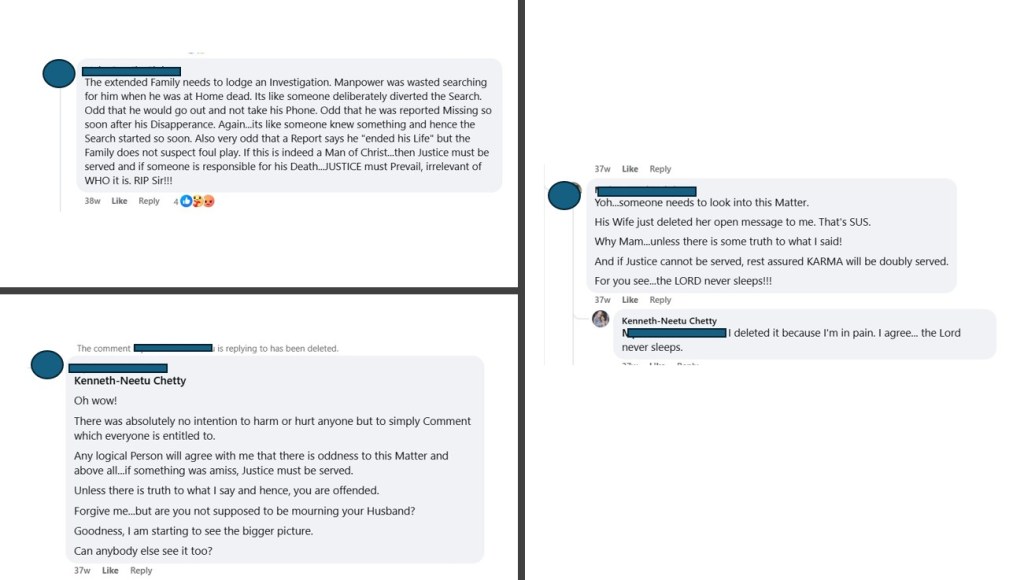
A comment. Not grief-stricken. Not compassionate. Not human. It did not mourn. It suspected.
It suggested oddness. It implied diversion. It leaned. ever so politely, toward the idea that something was being concealed. No facts. No proximity. No understanding of who we were, what we had lived, or what my children and I were surviving in those hours. Just conjecture, offered publicly, with the confidence of someone who had mistaken access for authority. As is the nature of social media…. I do not doubt that there are others like this….some which have been forwarded to me.
Let us be very clear about what this is. This is not concern. This is not justice-seeking. This is not discernment. This is the cheap thrill of narrative-building. The same reflex fed by headlines and rewards premature certainty. The same instinct that believes tragedy must entertain to be taken seriously.
At that moment, my children and I were not managing optics. We were managing breathe. We were surrounded by family, barely functional, trying to keep our bodies upright long enough to survive the next hour. And yet, someone who knew nothing about us felt entitled to introduce suspicion into a space that had not yet even held truth.
In my vulnerability, I responded.
Not with rage. Not with accusation. But with honesty. I said I was in pain. I affirmed my faith. I spoke from the raw centre of loss. And then .. something stopped me.
I asked myself a question that would come to define this season:
Who deserves access to our grief?
The answer was immediate.
Not everyone.
So I deleted my response. Not because I had something to hide. Not because I was intimidated. But because I realised that explanation is not protection, and engagement is not wisdom. Silence, in that moment, felt more sacred than speech.
What followed revealed the true danger.
The reply that came after my withdrawal was not softened by empathy. It did not retreat. It escalated. It questioned my right to mourn. It reframed restraint as implication. It carried the unmistakable tone of someone less interested in understanding than in steering … someone who needed a narrative… who was prepared to construct one if none was provided…like many others, I am sure who gleefully thrive in toxic behaviour.
This is where speculation becomes harmful.
Because comments like these do not exist in isolation. They shape atmosphere. They condition perception. They are absorbed by readers who lack context. They echo what unverified media assumptions suggest but cannot lawfully assert. They become part of the background noise against which later assumptions are made… assumptions that subtly influence how people interpret silence, grief, and dignity.
I remember sitting with my phone in my hand, thinking not of myself, but of my children.. Thinking of the day they might read these words, online and how casually strangers can project stories onto lives they do not know. How easily a father’s legacy can be bruised by implication. How quickly dignity becomes collateral damage. With this blog post my hope is that they feel encouraged by the strength that their Dad saw in me. One being to confront and call out these behaviours to ensure that others in similar positions know they have a voice to do the same
What struck me most was how rare that comment was.
Among hundreds of messages filled with compassion, it stood alone. A single voice choosing conjecture while others chose love. A reminder that even in moments of communal grief, there will always be those who mistake proximity for permission, and curiosity for calling.
I do not share this to vilify. I share it to document.
Because moments like this matter. They reveal how quickly speculation can move from the margins to the mainstream when truth has not yet been honoured. They show the quiet danger of narrative pressure in the earliest hours of loss when families are most vulnerable, and restraint is most easily misread. In those early days, I learned something sobering. Grief does not just strip you. It reveals others. And in that revealing, God was already teaching me discernment , how to guard what remained holy, how to withdraw without shrinking, how to trust that truth does not need a defence team when it has integrity.
This is why words matter.
This is why speculation is not neutral.
This is why careless narratives are dangerous.
Because when grief becomes public property, the most vulnerable always pay the price.
“When exactly did grief become a community discussion item and who appointed the panel?”
“Do not follow a crowd to do evil.” — Exodus 23:2
What emerged later quietly at first, then with increasing clarity was something far more disturbing than headlines or comment sections. It was the realisation of what was being said behind closed doors.
At dinner tables. In WhatsApp groups. At corner stops and casual gatherings where tragedy becomes currency and speculation passes for conversation . I learned slowly, painfully, that there were people who believed they had the right to discuss my husband’s death as if it were a topic, not a life. As if it were an event, not a wound. And then came the moment that stopped me cold. The suggestion arrived not as an accusation, but as insinuation, the casual cruelty of gossip masquerading as insight. A whisper dressed as wisdom. The implication that infidelity had touched our marriage. At the time, its audacity cut deeper than anger ever could. Not because it misunderstood us, but because it desecrated what we held sacred. Kenneth and I did not treat marriage as convenience or performance. We understood it as a covenant, holy, deliberate, guarded. A vow not merely witnessed by people, but consecrated before God. To question that was not merely to speculate about a relationship. It was to trample something we had spent a lifetime honouring.. It cut deep at the time.
I remember the confusion more than the anger. The genuine disorientation of realising that this was not ignorance, but something far uglier: a reflex. The reflex of small minds when confronted with grief they cannot comprehend. When love that was real, deep, visible, and fought for threatens the narratives they rely on to feel superior, safe, or entertained. When a marriage grounded in faith does not fit the story they need in order to make sense of loss..
I understand now that such speculation rarely reveals anything about the marriage it targets. It reveals the lens through which the speaker views the institution itself.. When covenant is devalued, it is easily projected onto others. When fidelity is treated as fiction, it becomes convenient to doubt its existence anywhere. What was deflected onto my marriage was not truth, but limitation. It was an inability to recognise, or perhaps to believe in, a union held with reverence. And so what they questioned was not our faithfulness, but their own understanding of what holiness in marriage looks like. What followed was a reckoning.
I found myself sitting with a senior Pastor, a man whose role is discernment, not flattery , who felt compelled to say to me, unprompted, that my credibility, integrity and good character was “unquestionable.” I nodded politely, while something inside me faltered.
Why would that need to be said?
And then it landed.
Because somewhere along the way, credibility had been placed on trial, not by facts, not by evidence, not by truth but by gossip. By people whose lives are so narrow that they require scandal to feel substantial. By those who mistake proximity for insight, and malice for discernment. Not all. Never all. But enough to reveal something deeply broken.
What struck me most was not the accusation itself, but the confidence with which it was imagined. The ease with which strangers felt entitled to rewrite a marriage they did not witness, a faith they did not live, a family they did not know.
And the comments did not stop at implication. They multiplied. That perhaps the marriage was not what it appeared to be. That surely there must have been something , because loss, in their minds, requires scandal in order to be intelligible.
I did not hear these things directly at first. They reached me the way poison often does , filtered, diluted, repeated just enough times to confirm that they were circulating freely. Each retelling carried the same undertone: suspicion dressed as conversation, cruelty disguised as curiosity.
People spoke with certainty about things they had no knowledge of.. They spoke as though my husband’s death was not the collapse of a family, but a puzzle they were entitled to solve for entertainment.
People who had never sat at our table. Never watched my husband pray over his children or me. Never witnessed the ordinary faithfulness of our life together. And yet they spoke.
They speculated about my character.
They questioned my integrity.
They discussed my credibility as though it were a matter for communal debate.
This is not cultural curiosity.
This is not community concern.
This is moral underdevelopment.
It is what happens when people lack the intellectual discipline to sit with uncertainty, and the spiritual maturity to honour grief. When speculation becomes sport, and cruelty hides behind familiarity. When faith language remains, but the discipline of love has eroded. And here is the truth that no amount of gossip can outrun: People who engage in this kind of speculation do not expose the lives of others . Tbey expose tbeir own moral.degradation. They expose their own limitations. But the cost of it …the cost of was having to shield my children not only from loss, but from narrative violence….something no family should ever have to bear. We lost the centre of our home.
And then, astonishingly, we had to defend the integrity of our love from people who had no seat at our table and no standing in our story. That was the second wound. Not loud. Not official. But intimate.
The violence of being spoken about, rather than spoken to.
Of having your life discussed as theory while you are still learning how to breathe without the person who anchored your world. That was when I understood something fundamental. Grief does not just test the heart. It tests the moral maturity of the room. AND NOT EVERYONE PASSES.
THE LESSON?
What I have learned through this has been sobering. Speculation does not announce itself as cruelty. It rarely arrives shouting. More often, it wears the language of curiosity. Of concern. Of people who are “just asking questions.” But when those questions are asked without proximity, without knowledge, and without care, they become something else entirely. They become pressure.
Pressure on grieving families to perform pain correctly.
Pressure to explain silence.
Pressure to justify restraint.
Pressure to survive publicly while barely surviving at all.
And when that pressure is allowed to circulate unchecked, through headlines, comment sections, whispers dressed as insight, it does more than wound emotionally. It shapes perception. It influences urgency. It determines which questions are pursued, which are ignored, and how seriously truth itself is treated.
This is where the damage multiplies.
Because what families experience in moments like these is not only loss, it is secondary trauma. Trauma inflicted not by the event itself, but by the noise that follows. By careless narratives. By institutional hesitation. By social speculation that erodes dignity while pretending to seek clarity.
And then..there is our journey with The South African Police Services. There will be more to be said about that experience: about delays, silences, assurances, without movement, protocols and the quiet cost of having to push for answers while still in shock. Those reflections will be written carefully, responsibly, and in full awareness of the weight they carry, whilst in recognition of the hard work of those (not all) members of SAPS who carry out their mandate with diligence, care and protocol adherence. They matter not only for us, but because many families endure these systems without voice, without language, without the safety to speak at all and without understanding how the law operates.
What we have learned must not be wasted.
My children and I did not consent to becoming a narrative. We did not offer our grief as public property…. it was thrown at is….and as such we have a right to respond. We were living inside loss , not analysing it from a distance. And yet, even here, God is present. Teaching me that peace is not passivity. That silence is not surrender. That discernment is strength, not retreat.
I have learned how to withdraw without disappearing.
How to guard what is sacred without becoming small.
How to trust that truth does not require performance in order to endure.
My husband always knew this about me ….that I would stand where others could not. That I would speak when silence protected the wrong things. I believe he loved that about me as deeply as I loved his compassion, his purity, his ability to care without condition, and to love without calculation.
And so I will do what he loved best about me.
Not to condemn.
But to call to account.
Not to humiliate.
But to invite reflection.
Not to hurt but to insist on growth where hypocrisy has gone unchallenged for too long.
Because love still speaks. And sometimes, love speaks by refusing to look away. OUR COMMUNITIES CAN DO BETTER.
If you are reading this and recognising yourself, If you too have had to grieve while being watched, questioned, or quietly judged, know this: you are not alone. What you felt was real. The pressure was real. The harm was real. And your instinct to withdraw, to guard, to survive rather than explain was not weakness …it was wisdom.
There is a voice for you too. It may come later. It may come softly. Or it may come like fire. But it belongs to you, and it does not require permission. Truth does not disappear because it is quiet it waits. I am reaching out a hand of support to you , not as someone who has all the answers, but as someone who has survived the questions. Reach back.
 Mend
Mend 
Leave a comment